Free Bedtime Stories for Little Dreamers
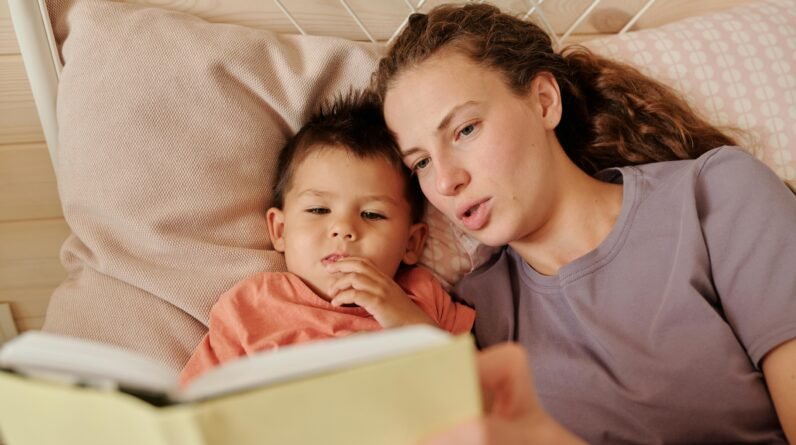
You will find here short, gentle stories you can read in five minutes. They are meant to be simple, small invitations to sleep — not adventures that insist on staying up past bedtime.
Why 5‑Minute Stories Work
Five minutes is long enough to open a small world and short enough to fit into a tired evening. You will be giving a rhythm: arrival, a small scene, and a soft closing, and that rhythm helps children understand endings and rest.
The rhythms of short stories
Short stories calm because they move without fuss. You will notice how a few well-chosen images can do what paragraphs and plot usually do, only quieter.
How attention spans fit
Young children’s minds are swift and honest; they tell you when they are finished. You will find that five minutes often matches their curiosity and still leaves room for sleep to come without a struggle.
How to Use These Free Stories
These stories are for reading aloud, for whispering, and for the small conversation you might have after the lights go down. You will learn how to pace, when to pause, and how to make a page of words feel like a soft room.
Preparing the space
Turn the lights down, but not so dark that your voice feels far away. You will want a place where both of you can breathe and where the story becomes something between you.
Reading aloud tips
Use a slow voice and let silence be part of the sentence. You will find pauses are where children add their own colors to the tale.
Adjusting for age and mood
Some nights a child needs a laugh; other nights, a lullaby in words. You will judge by their breath and by the way their fingers stop fiddling.
Where to Find Free 5‑Minute Bedtime Stories
There are many gentle resources online and in public libraries that offer short stories at no cost. You will want trustworthy, ad‑free or low‑ad settings, because sensory clutter undoes the calm you are making.
Source type | What you’ll find | Good for |
|---|---|---|
Public library apps (Libby, OverDrive) | Audiobooks and ebooks for children | Screen-free listening, free with library card |
Author and educator websites | Short downloadable stories and printable sheets | Customizable and often free to share at home |
Podcast episodes for kids | 5–15 minute narrated tales | When you need hands-free storytelling |
YouTube kids channels | Short animated bedtime stories | Visuals for very young listeners; use parental controls |
Community story groups | Local story hours or volunteer storytellers | Live, social reading experiences |
You will check the settings and previews. Some content calls itself “for children” but suits different ages and tastes.

How to Choose a Story Right Now
You will pick according to length, subject, and the child’s mood. A quick table can help you decide in the few seconds before you solve tonight’s problem of how to end the day kindly.
Mood of the child | Type of story to choose | Why it works |
|---|---|---|
Restless | Repetitive, rhythmic story | Predictable language so the child can anticipate and settle |
Quiet and reflective | Lyrical, image‑rich story | Words that feel like curtains closing slowly |
Sad or anxious | Reassuring, small rescue stories | Small wins help mood recalibrate |
Energetic or excited | Short, humorous vignette | Laughter can soften into sleep if you slow the finish |
Curious | Gentle mystery or wonder | Curiosity satisfied by a tidy conclusion |
You will trust your sense of what will help tonight. There is no single right choice.
How to Make Your Own Five‑Minute Bedtime Story
You will find power in simplicity. A homegrown story will feel intimate because it carries your voice and the particularities of your child’s small life.
Basic structure you can follow
Keep a clear beginning, a small middle, and a gentle ending. You will notice that the clearest endings are the ones that invite sleep rather than postponing it.
Elements to include
Use one setting, one small problem or discovery, and one comforting conclusion. You will weave in sensory details — a color, a sound, a feather against a cheek — and these will make the story feel real.
Element | How long in your five minutes | Example |
|---|---|---|
Opening line | 20–30 seconds | “Once, when the moon forgot how to be round…” |
Small scene | 2–3 minutes | A child/animal meets something curious |
Resolution | 1–1.5 minutes | A tidy, calming solution |
Final lull | 30–60 seconds | A repeating phrase or a soft visual to close |
You will practice this once or twice and then find that the form becomes a comfortable habit you return to.
This image is property of images.pexels.com.
A Few Gentle Rules You Can Use
You will want a few rules to guide the story so it does not unravel into something wide awake.
Keep conflict small or symbolic; avoid anything that triggers fear.
Keep the ending reassuring and not cliff‑hung.
Use sensory details to anchor the scene in the body.
Let the child’s name appear if it helps them enter the story.
Repeat a line at the end to create a closing ritual.
You will see how these rules make the story less about “what happens next” and more about “what it feels like.”
Sample Five‑Minute Bedtime Stories
Below are five original short stories you can read aloud tonight. Before each story there are two short sentences that tell you the mood and a tiny suggestion for how to read it. You will find quiet images and unhurried sentences. Read them softly, and allow a pause where you see a natural breath.
The Moon’s Little Neighbor
This story is luminous and calm. Read it with a slow, thoughtful voice and pause where the moon listens.
There was once a small house on a lane where the lamps kept their own hours and the cat slept in a mitten. The children in the house called it the House of Always‑Lights because, even when it was late, there seemed to be a small glow in one window, like a pocket of day.
On a night when the moon felt very lonely, it leaned a little closer to the earth and noticed a tiny rooftop garden next to the chimney of the small house. The moon loved gardens, especially those that gave up smells instead of demands — mint that unfolded like whispers, a rosemary that smelled like steady hands.
A little boy named Tomas tended the rooftop garden. He planted beans that climbed the chimney and a sunflower that refused to face the sun. Tomas noticed the moon too, with its patient silver face, and every night he would set a small saucer of warm milk on the windowsill. It was nothing for the moon to eat, but it was a ceremony. The moon would dip a beam and taste the gentle light of the milk. The milk would cool and shine like a tiny lake.
One night the moon’s brightness seemed thin. Tomas put on his slippers, climbed the ladder that led to the roof, and sat beside the sunflower. He said, plainly, “Are you tired?” The moon hummed a sound like a distant bell and then sent down a leaf that had been touched by its light. Tomas gathered the leaf and tucked it under his pillow.
From that night on, whenever the moon felt a little small, it remembered the house on the lane and leaned nearer. The rooftop garden grew strange blossoms that only opened by moonlight, and the neighbors would say the house smelled of warm milk most evenings. Tomas felt the moon’s weight like a hand on the back of a chair, steady and kind.
When you finish the story, rest your hand on your child’s shoulder and say the last line again: “The moon remembered the house, the house remembered the moon, and everyone slept.”
This story is playful and tender. Read it a touch faster for the mischief, then slow down as the stars settle.
Milo found the pocket by accident when he reached into his coat and pulled out a handful of night. It was soft and smelled faintly of lavender, and a few tiny pinpricks of light rested in the hollow like shy insects. Milo thought perhaps his mother had stitched the pocket wrong or that he had simply invented it.
He held the pocket up to the window and let the stars spill into the room. They scuttled across the rug, hiding under the bookshelf, and climbed the curtains like small, bright mice. Milo laughed, a small, surprised laugh, and the moon outside leaned in to listen.
Milo’s sister, Ada, woke and found a star curled against her pillow like a warm grape. She blew on it and it made the sound of little bells. “We should keep them,” she whispered, “but we should also let them go home.” So they took the stars in tiny paper cups and walked the length of the garden, past the sleeping row of beans and the fence that remembered when it had been a gate.
At the edge of the garden, Milo opened his coat, and the stars rose like poppies in the night. They clustered around the old elm tree and then, one by one, they set themselves in the sky. The pocket had been a temporary place; its job was to show Milo how near the stars might sometimes feel.
When you close the book, whisper: “Stars tuck themselves back where they belong,” and leave a hush like a blanket over the room.
This story is reflective, meant for evenings when small hands still tremble. Read it slowly and let the child watch for the small changes.
There was a garden no one walked through except at very particular times — when the light was fat and the air was the color of soft bread. It was a garden of tiny things: an almost‑invisible pond, a bench that had learned to hold itself comfortably, and a hedgehog that kept a single acorn in his pocket.
A girl named Ruth learned the names of the plants. She spoke to the lavender as if it were a wise friend, and the lavender answered in scent. Once, when the world outside had been noisy with shouting and sudden bright signs, Ruth came to the garden and sat on the bench. She counted the ripples on the pond and watched how each ripple said goodbye to its neighbor.
One evening, when rain had been announced but had not yet come, a small cloud wandered into the garden as if lost. It looked like a puff of cotton that had decided to stop running. Ruth offered it a place on the bench, and the hedgehog rolled his acorn forward like a small, serious gift. The cloud rested there and began to cry soft, honest drops. The drops made little suns in the pond and the hedgehog’s acorn shone with wet.
When the cloud felt lighter it told Ruth things clouds say when they are quiet. It promised to remember the bench and to send rain only when the world needed it. Ruth understood. She wrapped a scarf around her shoulders even though it was not cold, and she watched as the cloud floated away, leaving a faint smell of something like fresh paper.
You will finish by saying the last line again: “Some gardens keep secrets only when you listen,” and then sit very still with the child for a moment.
Lola’s Paper Boat
This story is small and brave. Read with a cheerful warmth that slowly softens to comfort.
Lola made a boat out of a page from a book. She folded it with fingers that knew how to make small things right. The boat was not grand; it had a little tear one side and a stubborn fold at the bow that made it lean as if it had already learned to go its own way.
She carried it to the puddle behind her house, a puddle that liked to pretend it was the ocean. The boat bobbed and made a trail like a thought. Lola put a pebble inside for ballast and a leaf as a sail. For a time the boat carried her wishes — a wish for a new blue sweater and a wish that her neighbor’s dog would stop howling at midnight.
A boy came to the puddle and asked if he could share the boat. Lola considered this as if it were the most important question in the world and then nodded. They took turns setting the boat free. Each time it sailed, they whispered a wish and then, when it reached the rim of the puddle, the boat would rock and turn back like a small answer.
When the sun went down, Lola tucked the boat into her pocket. She told it: “We will have other oceans.” The pebble had become warm from being handled and the leaf smelled faintly of summer. You will say to your child: “Small boats remember the places that loved them,” and let that be enough.
The Owl Who Forgot to Hoot
This story is gentle with a little humor. Read it in a playful voice at first, then soften as the owl learns to listen.
Near the edge of a wood, where the trees kept their own slow counsel, there lived an owl who had forgotten how to hoot. He remembered everything else — the places where mice liked to hide, the best way to tilt a head to catch the wind — but at night, when other owls spoke in round, sure notes, he kept his mouth small and silent.
The other owls didn’t mind at first, because he was clever in other ways. He could find missing buttons and knew which mushrooms were actually small umbrellas. But the moon began to miss the owl’s hoot as if it were a missing stitch in a familiar sweater. The moon hummed the way the sky remembers song, and the owl listened and felt something inside him like a locked porch.
A little fox, who liked to collect small things, decided to help. He crept to the owl’s branch with a tiny jar of honey and a question. “Do you remember the sound of saying?” he asked. The owl shook his head so gently that the leaves did not know whether to fall.
Together they practiced. The fox whispered the vowels the way you press flowers in a book, and the owl tried shapes: o, u, a. First there was only a small rustle, then a note like the last breath of a bell. It was not perfect. It was not like the other owls’ confident hoots. It was something new and honest, and the moon tilted and listened as if understanding a sentence that had once seemed impossible.
By morning the owl’s voice was not the loudest, but it was a voice that knew what it had waited to say. The fox kept his jar of honey for another day, and the owl learned that some sounds take a while to remember. You will close by saying: “And so the whole forest learned to listen to small beginnings,” and hold the silence for a time.
How to Finish a Story So Sleep Can Follow
Endings should feel like a hand closing gently around another hand. You will use repetition, a small physical ritual (a kiss, a stroke), and a line that signals rest without asking for permission to leave.
Repeat a comforting phrase.
Lower your voice by a notch each sentence.
Stay for a little while after the last word.
You will let the story’s last image be soft — a blanket, a light that dims, a hand on a shoulder.
Age Adaptations: Making the Same Story Work at Different Ages
You will often have siblings or different nights with different needs. The same short story can be tuned by language and by how much detail you offer.
Age range | How to adjust | What to keep |
|---|---|---|
0–2 years | Use fewer words, more rhythm, and physical cues | Repeat and slow the cadence |
3–5 years | Add small characters and concrete actions | Keep scenes simple and visual |
6–8 years | Add a mild twist or a short moral | Allow a question or a tiny mystery |
9–12 years | Offer deeper emotion and subtlety | Keep the pacing brisk but reflective |
You will be guided by your child’s responses rather than a chart; the table is a starting place.
Sometimes you will need a story when your voice is tired or when a different voice comforts best. There are many free audiobooks and printable story packs available from libraries and educational sites.
Use library apps to borrow audiobooks for free.
Search public domain collections for classic short tales.
Print a single page of a story and read from it as if it were a tiny map.
You will check permissions if you share copyrighted material outside your home.

Safety, Copyright, and Sharing
If you find a story you love online, you will note whether it is free to download, whether it’s public domain, or whether it’s offered under a creator’s generous license. You will respect the work and attribute it when required.
Public domain texts are safe to print and share.
Creative Commons licenses vary — look for those that allow noncommercial use.
For podcasts and videos, check the platform’s terms and the creator’s notes.
You will want to teach your child that stories come from people, and people’s work deserves care.
A Bedtime Routine You Can Try Tonight
A small table to help you manage the minutes before lights out. You will customize it for your own house and the child you know.
Minute mark | Activity | Notes |
|---|---|---|
-10 | Bathroom and teeth | Finish active tasks before the story |
-5 | Pajamas and tuck | Comfortable clothes ease sleep |
0 | Story begins | Keep it to five minutes |
+5 | Quiet talk and a kiss | One or two sentences of connection |
+2 | Lights down | A consistent signal that it’s over |
You will make this ritual yours. Repetition is what makes it restful.
Troubleshooting Common Bedtime Challenges
You will sometimes face resistance, questions, or prolonged energy. Here are small tactics that tend to work across nights.
If the child asks for “just one more,” give a tiny ritual like a whispered promise and a timer.
If they interrupt the story to correct you, ask them to whisper their correction and tuck it into the story like a pressed leaf.
If they are frightened, turn the scary detail into something small and silly.
You will remember that patience is a gift you give both the child and yourself.
Closing Thoughts
You will find that the act of reading a short, free story at night becomes less about the content and more about the steadiness you offer. The stories here are modest and kind; they do not ask for heroism, only attention and comfort. You will come back to a few favorites, and these will become the furniture of your evenings — worn, familiar, and necessary.
If you try one tonight, choose the one that matches the breath in the room. Speak slowly, leave room for silence, and let the finishing image be soft enough to slide into. You will be surprised how quickly small words can gather into sleep.
Get more creative knowledge build books and resources for happy minds at: https://booksforminds.com/