Bedtime Stories for Overstimulated Kids: Gentle Bedtime Stories for Overstimulated Kids for Restless Evenings
Bedtime stories for overstimulated kids work best when they reduce demands rather than add more stimulation. A simple plot, slower pacing, repeated phrases, soft imagery, and a reassuring ending can give a restless child something gentle to focus on while the evening moves toward quiet.
Reading bedtime stories for overstimulated kids can help create a calming atmosphere.
Some children reach bedtime physically tired but mentally busy. They may still be thinking about play, conversations, screens, exciting events, disappointments, noise, or changes that happened during the day.
The goal of a calming story is not to force sleep or make difficult feelings disappear. It is to create a lower-stimulation transition.
Below you will find two original bedtime stories for restless children, practical reading guidance, simple ways to reduce stimulation before storytime, and ideas for deciding when a short story is more useful than a longer one.
These bedtime stories for overstimulated kids are designed to soothe and relax, making bedtime easier.
Key Takeaways
- Overstimulated children often benefit from fewer choices and lower emotional intensity before bed.
- Calming stories should use simple plots, gentle imagery, repetition, and clear endings.
- A bedtime story does not need to make a child fall asleep quickly to be useful.
- Breathing prompts are optional; do not turn relaxation into another task the child must perform correctly.
- Familiar stories may work better than new adventures after a very busy day.
- Avoid suspense, frightening themes, cliffhangers, and complicated participation when a child already seems overloaded.
- Persistent sleep problems, anxiety, breathing concerns, or significant distress may need appropriate professional support.
Why Some Kids Feel Overstimulated at Bedtime
Understanding how bedtime stories for overstimulated kids can help is crucial for creating a relaxing bedtime routine.
Bedtime can arrive before a child’s mind has fully caught up with the change in pace.
Possible contributors include:
- a busy preschool or school day,
- active play close to bedtime,
- lots of noise or social interaction,
- screen use,
- strong emotions,
- sensory sensitivity,
- unexpected changes, and
- difficulty moving from one activity to another.
Different children show overstimulation differently.
One child may become silly and energetic.
Another may cry easily.
Another may ask dozens of questions.
Another may seem tired but unable to stop moving.
When a child is already overstimulated, bedtime usually benefits from subtraction: fewer choices, fewer demands, less noise, less emotional intensity, and a simpler story.
For a deeper explanation of common triggers and patterns, see
How Overstimulation Affects Bedtime
.

What Makes a Good Bedtime Story for an Overstimulated Child?
Choosing the right bedtime stories for overstimulated kids can set the tone for a peaceful night.
The most useful story is usually not the most exciting one in the stack.
Keep the Plot Simple
One character and one small problem may be enough.
Examples:
- a lantern trying to shine more softly,
- a cloud learning to move with the evening wind,
- a rabbit looking for a blanket, or
- a little star returning home.
Use Repetition
Familiar phrases make the emotional direction easier to predict.
“Softly now.
Slowly now.
The meadow is growing quiet.”
Choose Gentle Imagery
Useful settings include:
- moonlight,
- clouds,
- quiet meadows,
- warm blankets,
- soft rain,
- sleepy animals, and
- dimly glowing stars.
Keep Conflict Low
Avoid making the child wait through danger or suspense for the reassuring part.
End Clearly
At bedtime, uncertainty can be more stimulating than closure.
Let the character:
- return home,
- find what was missing,
- receive reassurance,
- say goodnight, or
- settle somewhere safe.
Gentle Bedtime Story 1: The Little Lantern Who Learned to Glow Softly
This gentle bedtime story for overstimulated kids encourages relaxation and calmness.
In a quiet meadow where the grass moved gently beneath the evening sky, there lived a tiny lantern named Luma.
Luma loved light.
She sparkled in the morning.
She shimmered in the afternoon.
She flashed brightly whenever a butterfly passed.
But one evening, Luma noticed something.
The sun had disappeared behind the hills.
The meadow had become quieter.
And the fireflies were beginning to glow more softly.
“Why are your lights so small?” Luma asked.
One firefly floated beside her.
“They aren’t smaller,” he said. “We’re simply using a softer glow tonight.”
Luma tried.
Flicker.
Flash.
Sparkle.
“I can’t do it,” she said.
The firefly stayed beside her.
“You don’t need to switch yourself off.”
Luma looked at him.
“I don’t?”
“No. Just notice the meadow.”
Luma listened.
The grass moved:
swish…
swish…
A leaf drifted down.
The moon appeared above the hill.
Luma’s light was still glowing.
But now it was warm instead of flashy.
Steady instead of busy.
Soft instead of bright.
“I’m still shining,” she whispered.
“Of course,” said the firefly.
Luma watched the moon.
The meadow grew quieter.
Her little light glowed beside the grass.
Nothing else needed to happen.
And that was enough for the night.
How to Read This Story to an Overstimulated Child
You do not need to read unnaturally slowly.
Instead:
- use a comfortable, warm voice,
- leave small pauses between short paragraphs,
- avoid adding loud character voices,
- let repeated words remain simple, and
- allow your child to listen without answering questions.
You might repeat:
“Warm instead of flashy.
Steady instead of busy.
Soft instead of bright.”
Only repeat it if your child enjoys the rhythm. There is no need to turn it into an exercise.
Watch: Relaxing Bedtime Story for Kids

Gentle Bedtime Story 2: The Cloud That Learned to Float Slowly
Another great option is to explore more bedtime stories for overstimulated kids that focus on tranquility.
High above a quiet valley, where the hills curved like blankets, lived a small cloud named Nimbus.
Nimbus loved to move.
He zipped across the sky.
He stretched wide.
He swirled around.
Sometimes he raced his own shadow.
But every evening, when the sky turned peach and gold, the other clouds began to slow down.
They drifted.
They floated.
They barely seemed to move.
“Why are you all going so slowly?” Nimbus asked.
An old silver cloud floated beside him.
“Because evening is changing the sky.”
“But I’m not ready to stop,” said Nimbus.
“You don’t have to stop.”
Nimbus looked surprised.
“Really?”
“Really. You can keep moving. Just try moving with me.”
The silver cloud drifted slowly.
Nimbus tried to follow.
At first he wiggled.
Then he bounced.
Then one corner of him puffed outward for no particular reason.
The silver cloud smiled.
“That’s all right.”
They floated a little farther.
Nimbus noticed the first star.
Then the second.
Then a thin moon appeared above the hills.
Nimbus was still moving.
But he was not racing now.
He drifted beside the silver cloud.
Slowly.
Quietly.
Easily.
“I thought slowing down meant becoming still,” Nimbus said.
“Sometimes,” said the silver cloud, “it just means giving yourself more time.”
Nimbus liked that.
The sky grew deep blue.
The valley became quiet below.
Nimbus floated on.
No races.
No hurry.
Just one soft cloud moving through one quiet sky.
What to Do Before the Story Begins
If the entire evening is still fast and noisy, the story has to work much harder.
Try making the transition easier before you begin reading.
Reduce Activity Gradually
Move from energetic activity toward something quieter rather than expecting an instant switch.
Reduce Choices
Instead of:
“Which of these fifteen books do you want?”
try:
“Would you like Luma or Nimbus tonight?”
Keep the Environment Simple
Lowering household stimulation may include:
- quieter voices,
- less active play,
- fewer competing sounds,
- comfortable lighting, and
- a familiar story location.
For more ideas, see
How to Make Evenings Calmer Before Bed
.
How to Choose the Right Bedtime Story Tonight
| What You Notice | Story Approach |
|---|---|
| Your child is very tired | Choose one short familiar story |
| Your child is physically restless | Use simple imagery and do not require perfectly still listening |
| Your child is emotionally overwhelmed | Choose a story that allows feelings without demanding discussion |
| Your child is asking many questions | Use a predictable story they already know |
| Your child wants adventure | Choose a gentle discovery rather than danger or suspense |
| Your child is worried | Choose a non-scary story with a clear reassuring ending |
For especially sensitive evenings, explore
Slow Bedtime Stories for Sensitive Kids
.
Optional Gentle Breathing Prompt
Some children enjoy breathing with a character.
Invite your child to breathe slowly alongside the bedtime stories for overstimulated kids to enhance relaxation.
Others dislike being told how to breathe.
Treat this as an invitation rather than a requirement.
“Nimbus grew a little wider…
then softened again.You can take a comfortable breath with him if you want.
In…
and out…No hurry.
Then Nimbus kept floating.”
One or two gentle repetitions may be enough. There is no need for a fixed count.
What to Avoid When a Child Is Already Overstimulated
Consider saving these for another time:
- high-action plots,
- frightening villains,
- dramatic rescues,
- cliffhanger endings,
- lots of character voices,
- rapid-fire questions,
- too many choices, and
- long lessons about how the child “should” feel.
A good bedtime story can be engaging without being intense.
If your child is easily frightened by story content, explore
Non-Scary Bedtime Stories for Kids
.
Use the Story as Part of a Predictable Routine
A calming story works best when it has a clear place in the bedtime sequence.
Establishing a routine with bedtime stories for overstimulated kids can lead to better sleep habits.
For example:
- finish active play,
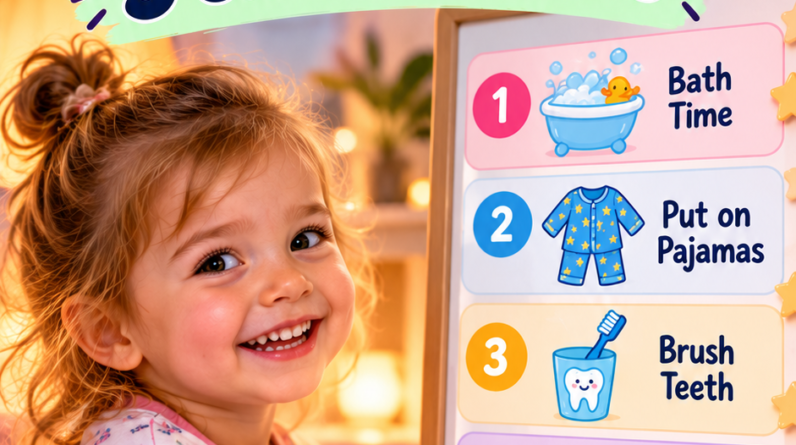
- complete washing and pajamas,
- move into a quieter room,
- choose one story,
- read together, and
- finish with a familiar goodnight phrase.
You do not need perfect timing every night.
The routine only needs to be recognizable enough for your child to know what comes next.
For a broader framework, see
Bedtime Routine That Actually Works
.
When a Bedtime Story Is Not Enough
When bedtime stories for overstimulated kids are not enough, consider other calming techniques.
Storytelling is one supportive bedtime tool.
It cannot address every reason a child struggles to settle.
Ongoing difficulties may also involve:
- bedtime anxiety,
- sleep schedule mismatch,
- persistent bedtime resistance,
- environmental discomfort,
- frequent waking,
- breathing problems during sleep, or
- other health or developmental concerns.
If your child’s sleep problems, anxiety, nighttime distress, breathing concerns, or daytime sleepiness are persistent or significant, consider discussing them with an appropriate healthcare professional.
Frequently Asked Questions About Bedtime Stories for Overstimulated Kids
Bedtime stories for overstimulated kids can play a crucial role in easing nighttime anxiety.
Are bedtime stories helpful for overstimulated children?
They can be. A simple, predictable story can replace more stimulating activity with one quieter focus. The story does not need to make the child sleep; it can simply make the transition toward bedtime gentler.
How can I tell if my child is overstimulated at bedtime?
Possible signs include unusual silliness, restlessness, emotional reactions, difficulty transitioning, repeated talking, or seeming tired but unable to slow down. These behaviors can have many causes, so look for patterns rather than assuming overstimulation is always the explanation.
What kind of bedtime story is best after a very busy day?
Try a familiar story with few characters, a simple problem, gentle imagery, low emotional intensity, and a clear reassuring ending.
How long should a bedtime story be for an overstimulated child?
There is no ideal number of minutes. On some evenings a very short story may work best. On others, a familiar longer story may be comfortable. Follow your child’s state and your normal bedtime rhythm rather than a fixed length.
Should I avoid exciting bedtime stories completely?
Not necessarily. Adventure stories can be wonderful at other times. If a child already seems overstimulated, however, bedtime may be a better time for lower-stakes stories without frightening scenes or cliffhangers.
Should I make my child breathe slowly during the story?
No. You can offer a gentle breathing invitation if your child enjoys it, but avoid making relaxation into a task they must complete correctly.
Can I reread the same calming story every night?
Yes. Familiarity can be helpful, and many young children enjoy repetition. You do not need to provide a new story every night.
What if the story makes my child more excited?
Shorten it, use fewer character voices, reduce participation, switch to a familiar story, or stop reading. The story should fit the child rather than the child having to fit the story.
Can bedtime stories treat anxiety or sleep problems?
Bedtime stories should not be treated as a medical or psychological treatment. They may support a calmer routine, but persistent anxiety or sleep difficulties may require guidance from an appropriate professional.
Final Thoughts
Bedtime stories for overstimulated kids are most useful when they make the evening simpler.
Overall, bedtime stories for overstimulated kids are an effective way to simplify the evening experience.
The story does not need to contain a big adventure.
Your child does not need to answer questions.
They do not need to breathe in a particular way.
They do not even need to become completely still.
Choose one gentle story.
Use a comfortable voice.
Leave a little space between sentences.
Let the ending become quieter than the beginning.
And remember:
An overstimulated child does not always need help doing more to calm down. Sometimes bedtime becomes easier when there is simply less to process.
Always remember that bedtime stories for overstimulated kids can help in reducing the complexity of bedtime.