Moon Bedtime Story for Kids: Gentle Moon Stories for Peaceful Evenings
A moon bedtime story for kids can turn the familiar nighttime sky into a gentle part of the bedtime routine. Quiet moonlight, sleepy clouds, twinkling stars, and reassuring characters create an imaginative setting without needing frightening villains, fast action, or dramatic cliffhangers.
For young children, especially those who sometimes feel uncertain about nighttime, a moon story can present the dark as peaceful and familiar: the moon is shining, the stars are settling, the animals are going home, and everyone is getting ready to rest.
Below you’ll find a short moon bedtime story to read tonight, 15 gentle story ideas, two reusable moon-story templates, practical read-aloud tips, bedtime-routine ideas, and answers to common parent questions.
Key Takeaways
- Moon stories naturally fit bedtime because their setting is already associated with nighttime.
- For a calming bedtime story, keep the problem small, the pacing gentle, and the ending reassuring.
- Young children often enjoy repeated phrases and familiar endings.
- The ideal story length depends on the individual child, their attention, and how tired they are.
- Printed stories can be useful when families want a screen-free storytime option.
- If video is used near bedtime, choose quiet content and avoid letting it replace a consistent wind-down routine.
- Repeating a favourite moon story is perfectly reasonable when your child finds familiarity comforting.
What Makes a Good Moon Bedtime Story for Kids?
A good moon bedtime story for kids uses simple language, gentle nighttime imagery, a small problem, a reassuring solution, and a calm ending. Familiar elements such as moonlight, sleepy stars, quiet animals, cozy blankets, and repeated goodnight phrases can make the story easy for young children to follow without adding unnecessary excitement.
For bedtime, the story does not need a major adventure. A cloud looking for somewhere to rest or a shy star needing reassurance can provide enough of a story while still allowing the ending to become quieter.
Why Moon Bedtime Stories Work So Well at Night
The Setting Already Belongs to Bedtime
The moon is one of the easiest story elements for children to connect with bedtime because they can often see it outside or recognize it as part of the night sky.
A story can transform familiar nighttime details into reassuring imagery:
- the moon watches quietly from the sky,
- stars settle into their places,
- animals return to cozy homes,
- clouds drift slowly, and
- the whole world becomes quieter.
Predictability Can Make Storytime Feel Familiar
Children often respond well to familiar bedtime sequences. When storytime happens in roughly the same part of the evening and ends with a recognizable closing phrase, it can become one predictable part of the family’s wind-down routine.
The story itself can reinforce that predictability through repeated lines such as:
“The stars are resting. The moon is near. It is time to rest here too.”
Moon Stories Can Make Nighttime Feel Friendlier
Some children feel uncertain about darkness. Rather than making darkness the source of danger, a gentle moon story can portray nighttime as quiet, familiar, and cared for.
The moon does not need to fight monsters or guard against frightening threats. It can simply be present while everyone settles safely into bed.
If your child particularly prefers reassuring stories without frightening themes, explore our
non-scary bedtime stories for kids
.

How to Make a Moon Bedtime Story Calm Instead of Exciting
Keep the Stakes Small
Bedtime does not need a complicated quest.
Gentle story problems might include:
- a cloud that cannot find its resting place,
- a star that feels shy,
- a rabbit looking for the path home,
- a lantern that has forgotten how to dim, or
- a moonbeam trying to find the right bedroom window.
Each problem can be solved slowly and reassuringly.
Use a Slower Read-Aloud Style
You do not need an exaggerated “sleepy voice.” Simply reduce the performance level as the story progresses.
- Read conversationally at the beginning.
- Pause naturally between important sentences.
- Avoid sudden loud character voices.
- Gradually soften your volume near the ending.
- Finish with a familiar goodnight phrase.
Use Repetition
A repeated sentence gives young children something familiar to anticipate.
“Slowly, softly, under the moon.”
That line could appear several times throughout a story and return once more at the ending.
Choose Story Length According to the Child
There is no universal number of minutes that makes a bedtime story appropriate for a particular age. A child who is already exhausted may need a two-minute story, while another may happily listen for longer.
| Stage | Useful Story Approach | What to Prioritize |
|---|---|---|
| Toddler | Very short story with repetition | Familiar objects, simple language, reassuring ending |
| Preschooler | Simple beginning, small problem, gentle resolution | Predictability, imagination, emotional safety |
| Early school age | Slightly richer story with a clear ending | Character, imagination, calm pacing |
| Older child | Longer story or short chapter | Meaningful theme with a satisfying stopping point |
On particularly tired evenings, shorter is often easier. Our
micro bedtime stories
provide another short-story option.
15 Gentle Moon Bedtime Story Ideas
Use these ideas when you want to improvise a bedtime story without accidentally creating a high-energy adventure.
- The Little Star That Forgot How to Twinkle — The moon reminds a worried star that it does not have to shine brightly every night.
- The Sleepy Little Cloud — A small cloud searches for the coziest place in the night sky to rest.
- The Moon’s Mailbox — The moon receives tiny goodnight notes from animals around the world.
- The Lantern That Wanted to Rest — A lantern learns that it does not need to stay bright all night.
- The Whale That Swam the Night Sky — A gentle sky whale glides slowly between the stars.
- The Fox Who Counted Fireflies — A little fox counts glowing lights on the way back to its den.
- The Moon Keeper’s Blanket — A soft silver blanket is shared with sleepy stars.
- The Quiet Parade — Forest animals walk home beneath the moon one by one.
- The Gentle Storm — A small cloud learns that after the rain, the night can become quiet again.
- The Rabbit’s Night Walk — A rabbit follows moonlight along the familiar path home.
- The Moonbeam at the Window — A moonbeam travels from the sky to say goodnight to a child.
- The Star That Needed a Friend — A shy star discovers that it does not have to twinkle alone.
- The Owl’s Last Goodnight — A gentle owl says goodnight to every part of the forest.
- The Moon’s Sleepy Garden — Flowers close their petals one by one beneath silver moonlight.
- The Cloud That Carried Dreams — A quiet cloud carries gentle wishes across the nighttime sky.
For more imaginative bedtime ideas, visit our
magical bedtime stories
.
Short Moon Bedtime Story: The Sleepy Little Cloud
This simple moon story can be read exactly as written or personalized with your child’s name.
Once there was a little cloud who had floated across the sky all day.
It had floated over tall trees.
It had floated over small houses.
It had floated over a pond where the water was becoming still.
Now the sky was dark blue, and the little cloud gave an enormous yawn.
“I think I’m tired,” said the cloud.
A gentle breeze passed by.
“Then you don’t need to hurry anymore,” whispered the breeze.
The cloud slowed down.
Slowly, softly, under the moon.
It passed one sleepy star.
“Goodnight,” said the star.
It passed another.
“Goodnight,” said that star too.
Soon the little cloud reached the moon.
“I’ve been looking for somewhere cozy to rest,” the cloud said.
The moon smiled.
“You can rest here for a while.”
The little cloud curled beside the moon.
Silver moonlight rested softly across its fluffy edges.
The cloud looked down.
The houses were quiet.
The pond was still.
The trees barely moved.
Everyone seemed to know that the busy part of the day was finished.
The little cloud yawned again.
Slowly, softly, under the moon.
“Goodnight, trees,” it whispered.
“Goodnight, pond.”
“Goodnight, little houses.”
Then the moon whispered:
“You have floated far enough for today. Now you can rest.”
The little cloud closed its sleepy eyes.
The stars stayed quietly in their places.
The moon shone softly.
And the little cloud drifted into the gentlest sleep.
Slowly, softly, under the moon.
Goodnight, little cloud.

How to Use a Moon Bedtime Story in Your Routine
The story does not need to become an elaborate bedtime system. Place it in a simple sequence your family can realistically repeat.
For example:
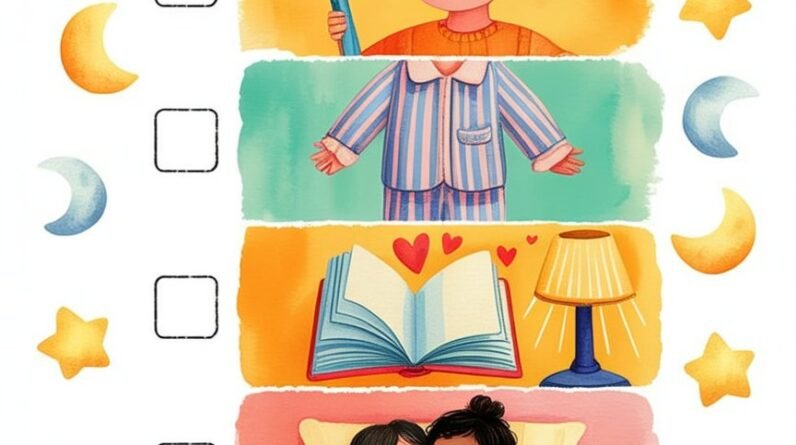
Teeth → Pajamas → Moon Story → Goodnight → Lights Out
Before the Story
- Reduce unnecessary noise.
- Use comfortable lighting.
- Finish high-energy games first.
- Have the book or story ready.
During the Story
- Use a comfortable, gentle voice.
- Keep interruptions minimal if your child is already settling.
- Allow your child to join repeated lines if they enjoy doing so.
- Keep questions optional.
After the Story
- Use a short familiar goodnight phrase.
- Avoid beginning a second exciting activity.
- Keep the transition to the next bedtime step predictable.
If your evening routine currently feels difficult to maintain, our guide to a
bedtime routine that actually works
offers a broader framework.
What About Animated Moon Bedtime Stories and Screens?
Some families enjoy bedtime story videos, while others prefer books or audio. The best choice depends on what helps your family maintain a calm and workable routine.
If you use a bedtime story video:
- choose slow, gentle content rather than fast-paced entertainment,
- keep the volume comfortable,
- avoid autoplay leading into unrelated videos,
- keep the transition after the video predictable, and
- consider books or audio if video seems to make your child more alert.
The story format matters less than whether the overall bedtime experience remains calm, consistent, and suitable for your child.
Books For Minds also has a guide to
gentle bedtime stories for children on YouTube
if your family uses video stories.
Why Keep Printable Moon Stories Available?
Printable bedtime stories can be useful when you want to read without a screen or keep the same story available across different situations.
They can be especially practical for:
- bedside reading,
- travel,
- visits with grandparents or caregivers,
- families who prefer physical story pages, and
- children who like returning to the same familiar story.
If printable stories suit your family, explore our
bedtime stories PDF for kids
resources.
Moon Bedtime Story Mini-Templates You Can Use Tonight
When you are tired and creativity has disappeared for the evening, a simple framework can help you improvise without turning bedtime into an accidental adventure series.
Template 1: The Moon Helps Someone Rest
Setup: The moon notices that someone is restless—a cloud, animal, toy, or child.
Gentle problem: The character cannot find a comfortable place or has forgotten how to settle.
Soft solution: The moon offers reassurance and a simple repeated phrase.
Ending: The character becomes comfortable, the surroundings become quiet, and the same closing line returns.
Example
“The little rabbit could not find the coziest place in the grass.
The moon sent one silver beam beside a warm tree.
The rabbit curled beneath it.
Slowly, softly, under the moon.”
Template 2: The Moon’s Quiet Job
Setup: The moon has one gentle nighttime responsibility.
Gentle problem: One little thing is not ready for bed.
Soft solution: The moon helps patiently.
Ending: Everything is settled and the moon says goodnight.
Example
“Every evening, the moon counted the stars before bedtime.
But one little star was hiding behind a cloud.
The moon waited patiently until the star peeked out.
Then she whispered, ‘There you are. Everyone is here. Now we can rest.’”
Three Gentle Closing Lines
- “Goodnight, little one. The moon is shining softly.”
- “The stars are resting. Now it is your turn.”
- “The night is quiet, the story is finished, and everything can rest.”
What If Your Child Asks Scary Questions During the Story?
Sometimes a peaceful moon or nighttime story reminds a child of something they find worrying.
You do not need to introduce additional frightening details to make the story more interesting. Acknowledge the question simply and bring the story back to something familiar and reassuring.
For example:
“You’re wondering about that sound. You’re safe here with me. In our story, the little rabbit can hear the quiet leaves outside while it settles into bed.”
If your child regularly finds bedtime frightening, our guide on
how to make bedtime feel safe
offers additional practical ideas.
Persistent or severe nighttime fears that are affecting a child’s sleep or wellbeing may be worth discussing with an appropriate healthcare professional.
What If Your Child Wants the Same Moon Story Every Night?
There is no need to replace a favourite story simply because your child already knows it.
Familiar stories allow children to anticipate what comes next and join in with favourite phrases. For some families, that predictability is one reason the story works well as part of bedtime.
If repeated requests start extending bedtime far beyond the agreed routine, keep the story familiar while maintaining the usual boundary around how many stories you read.
You can also make tiny changes without replacing the basic story:
- give one star a different name,
- change the animal the moon meets,
- change the colour of the cloud, or
- let your child choose the final goodnight phrase.
The structure remains familiar while one small detail feels new.
Frequently Asked Questions About Moon Bedtime Stories for Kids
Why are moon bedtime stories calming for many children?
Moon stories naturally use imagery associated with nighttime: quiet skies, soft light, stars, sleepy animals, and familiar bedtime routines. When the story also uses gentle pacing and a reassuring ending, it can fit naturally into a family’s wind-down period.
What makes a good moon bedtime story for toddlers?
A toddler moon story is usually easiest to follow when it has simple language, repetition, familiar objects or animals, very little conflict, and a clear ending. A moon saying goodnight to animals or helping a cloud find somewhere to rest can be enough.
What makes a good moon bedtime story for preschoolers?
Preschoolers can often enjoy a small imaginative problem, such as a shy star or lost moonbeam, as long as it is resolved gently. Repeated phrases and familiar bedtime imagery can help keep the story easy to follow.
How long should a moon bedtime story be?
There is no single correct length. Choose according to your child’s attention, age, story preference, and level of tiredness. On exhausted evenings, a two-minute story may be enough. On other nights, your child may enjoy a longer read-aloud.
Can moon bedtime stories help children who are afraid of the dark?
A gentle story can present nighttime through reassuring imagery and provide an opportunity for connection with a parent or caregiver. It should not be treated as a cure for nighttime fears, however. Persistent fears that significantly affect sleep or wellbeing may need additional support.
Should a bedtime story include an adventure?
It can, but the adventure does not need high stakes. A rabbit following moonlight home or a cloud searching for somewhere to rest provides movement and purpose without requiring villains, chases, or cliffhangers.
Is it okay to repeat the same moon story every night?
Yes. Many children enjoy repetition and knowing what happens next. If the story remains enjoyable for your family, there is no need to introduce a new one every night.
Are printable moon bedtime stories useful?
Printable stories provide a screen-free reading option and can make it easier to keep familiar stories available when travelling or when different caregivers handle bedtime.
Can I make up my own moon bedtime story?
Yes. Start with a familiar nighttime character, introduce one small problem, let the moon help in a gentle way, and finish with everything safe and settled. Repeating the same closing line can make improvising easier.
What are some good themes for a calming bedtime story?
Gentle themes include going home, saying goodnight, helping a friend, finding a cozy place to rest, watching stars, listening to quiet nighttime sounds, or returning something safely to where it belongs.
Final Thoughts
A moon bedtime story for kids does not need an elaborate plot to become memorable. A sleepy cloud, a patient moon, a quiet rabbit, or a handful of stars can provide enough imagination for a gentle story.
Keep the problem small. Let the story gradually become quieter. Give it a reassuring ending. And if your child asks for the same moon story tomorrow, there is nothing wrong with returning to a story that has become familiar.
Tonight, you can begin with one simple line:
“The moon was shining softly when everyone began getting ready for bed…”
Then let the moon do what it does best in a bedtime story: stay quietly in the sky while everything below settles for the night.