Short Bedtime Stories for Toddlers: Quick Sleep Tales
Short bedtime stories for toddlers can make storytime easier on evenings when
your child is already tired, restless, or ready for a simple transition towards sleep.
Toddlers do not need complicated plots or long adventures at bedtime. A familiar character,
a gentle setting, a little repetition, and a peaceful ending are often enough.
The stories below are intentionally short. Most can be read in about 2–5 minutes,
making them useful for toddlers with shorter attention spans and for families who want
storytime to have a clear beginning and ending.
You will find ten ready-to-read toddler sleep tales, guidance for choosing the right story length,
calming read-aloud tips, a simple bedtime story routine, story themes, a make-your-own-story template,
and answers to common parent questions.

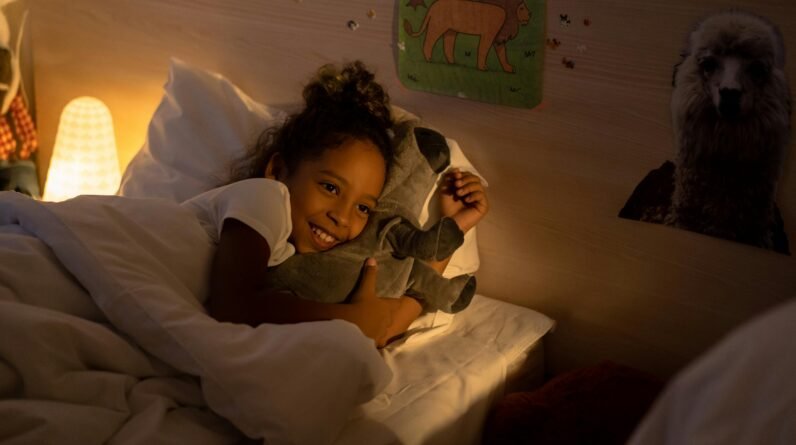
Image source: Unsplash.
Key Takeaways
-
Short bedtime stories for toddlers usually work best when they are simple,
calm, and easy to finish before attention begins to fade. - For many toddlers, a story lasting roughly 2–5 minutes is enough.
-
Use familiar themes such as animals, moonlight, blankets, toys, clouds,
gardens, and gentle bedtime routines. - Repetition can make a story more comforting rather than less interesting.
- Choose one predictable closing phrase so your toddler knows when storytime is finished.
- Avoid turning “one more story” into an open-ended negotiation after the agreed story is complete.
-
For broader toddler bedtime-story guidance, use our main
bedtime stories for toddlers
guide.
Watch a Short Bedtime Story for Toddlers
If your family sometimes uses a bedtime video, keep it to one calm story
and move directly into the final bedtime steps when it ends.
Why Short Bedtime Stories Work Well for Toddlers
Toddlers are still developing the ability to stay focused for long periods.
By bedtime, attention may be even shorter because your child has already spent
the day playing, learning, exploring, and managing many transitions.
A short story can fit naturally into this stage of development because it reaches
the reassuring ending before the child becomes bored, overstimulated, or frustrated.
Short sleep tales can also give bedtime a clear sequence:
Pyjamas → story → cuddle → goodnight.
Short Bedtime Stories May Be Especially Useful When Your Toddler:
- Has a short attention span before bed
- Frequently asks for “one more story”
- Finds transitions difficult
- Is already very tired
- Needs quiet connection before separation
- Becomes overstimulated by long or dramatic stories
If you want a broader selection of stories specifically for this age,
visit our
Bedtime Stories for Toddlers
guide.
What Makes a Good Toddler Bedtime Story?
A toddler bedtime story does not need a complicated plot.
At bedtime, simple is often better.
A useful structure is:
- One familiar main character
- One calm setting
- One small action or problem
- One reassuring resolution
- One repeated phrase
- One peaceful ending
Gentle Words That Fit Toddler Bedtime Stories
Words such as these naturally support a quieter tone:
- Soft
- Warm
- Quiet
- Slow
- Sleepy
- Still
- Cozy
- Safe
- Rest
- Goodnight
Avoid adding sudden danger, frightening characters, loud sound effects,
or cliffhanger endings immediately before sleep.
For children who are particularly sensitive to scary story elements,
see our
non-scary bedtime stories for kids
.
How Long Should a Toddler Bedtime Story Be?
There is no exact number of minutes that works for every child.
Use your toddler’s age, attention span, energy level, and evening routine as your guide.
| Age | Approximate Story Length | Useful Story Style |
|---|---|---|
| Around age 2 | 1–3 minutes | Very simple picture or micro stories |
| Around age 3 | 2–5 minutes | Animals, moon, blankets, toys, or bedtime routines |
| Around age 4 | 3–6 minutes | Simple imaginative stories with one gentle theme |
| Around ages 5–6 | 5–10 minutes | Preschool stories with slightly more plot |
If your child prefers extremely short stories,
explore our
micro bedtime stories
.
If your child is moving beyond toddler stories,
our
preschool bedtime stories
provide slightly longer options.
10 Short Bedtime Stories for Toddlers
These quick sleep tales use simple language, gentle repetition,
and clear endings so they can be read without turning bedtime
into a long storytelling session.
1. Moon Mouse
Best for: Ages 2–4
Approximate reading time: 2 minutes
Theme: Calm and safety
Little Mouse tiptoed towards the window.
The moon looked round and warm in the dark sky.
Mouse lifted one tiny paw.
“Good evening, Moon,” he whispered.
The moon seemed to glow a little brighter.
Mouse climbed into his small bed.
His pillow was soft.
His blanket was warm.
Outside, the stars blinked slowly.
“The day is finished,” Mouse whispered.
He tucked his paws beneath his chin.
“Goodnight, Moon.”
Then Little Mouse closed his eyes and rested until morning.
2. Soft Cloud
Best for: Ages 2–4
Approximate reading time: 2–3 minutes
Theme: Slowing down
A soft white cloud floated above a sleepy little town.
It was not in a hurry.
It floated slowly over the trees.
Slowly over the rooftops.
Slowly past the moon.
Then it drifted above one quiet bedroom.
Inside, a child was tucked beneath a warm blanket.
The cloud whispered:
“Soft and slow, sleepy dreams grow.”
The child smiled.
The cloud curled gently into the moonlight.
And the whole little town became quiet.
3. Bear’s Blanket
Best for: Ages 3–5
Approximate reading time: 3 minutes
Theme: Comfort
Bear was ready for bed, but something was missing.
“Where is my blanket?” he wondered.
He looked beside the chair.
Not there.
He looked under the pillow.
Not there.
Then Bear looked at the end of his bed.
There it was.
His favourite blanket was folded neatly and waiting for him.
“There you are,” Bear whispered.
He pulled the blanket up to his chin.
It was warm.
It was soft.
It smelled like home.
Bear smiled.
“My blanket is here. My bed is cozy. I can rest now.”
Then Bear closed his eyes.
4. Stars Say Goodnight
Best for: Ages 2–5
Approximate reading time: 2 minutes
Theme: Ending the day
One star blinked above the little house.
Then two stars blinked.
Then three.
Each star had one small goodnight to say.
The first star said:
“Goodnight, trees.”
The second star said:
“Goodnight, birds.”
The third star looked through the bedroom window.
“Goodnight, little one.”
The child smiled.
The stars blinked slowly.
“Goodnight, little light.”
And the room became still.
5. Tiny Truck Goes Home
Best for: Ages 3–5
Approximate reading time: 3 minutes
Theme: Routine and rest
Tiny Truck had been busy all day.
It carried blocks.
It carried socks.
It even carried one small teddy bear.
But when the sky outside turned purple, Tiny Truck knew it was time to stop.
It rolled slowly across the rug.
“Roll, roll, rest.”
Tiny Truck parked beside the toy box.
The blocks were still.
The socks were folded.
Teddy was tucked in.
Tiny Truck switched off its little headlights.
“Roll, roll, rest.”
And the bedroom became quiet.
6. The Quiet Garden
Best for: Ages 3–5
Approximate reading time: 3–4 minutes
Theme: Peaceful nature
In the quiet garden, every flower had a bedtime.
The red flower closed first.
The yellow flower closed next.
The blue flower waited for the moon.
A little bee rested on a leaf.
“Is it bedtime yet?” Bee asked.
“Almost,” whispered the garden.
The wind became softer.
The grass stopped dancing.
Then the moon appeared.
The blue flower gently closed its petals.
Bee tucked in beside the stem.
And the garden rested beneath the stars.
7. Pebble Friend
Best for: Ages 2–4
Approximate reading time: 2 minutes
Theme: Friendship
A small smooth pebble rested beside a quiet pond.
It did not hurry.
It simply sat beneath the moon.
A little frog hopped nearby.
“May I sit beside you?” Frog asked.
Pebble stayed still.
Frog decided that meant yes.
He sat beside Pebble.
The pond made tiny circles.
The moon made silver light.
Frog whispered:
“Resting is nice with a friend.”
Then Frog became still too.
8. The Sleepy Lighthouse
Best for: Ages 4–6
Approximate reading time: 4 minutes
Theme: Reassurance
Beside the quiet sea stood a little lighthouse.
Its light did not flash quickly.
It blinked slowly.
“Blink… rest. Blink… rest.”
The boats saw the light and knew where the shore was.
The waves rolled gently.
The gulls tucked their heads beneath their wings.
One little boat rocked softly on the water.
“The light is still there,” the boat whispered.
The lighthouse blinked again.
“Blink… rest. Blink… rest.”
And the sea became calm beneath the moon.
9. Molly’s Blue Blanket
Best for: Ages 2–5
Approximate reading time: 3 minutes
Theme: Familiar comfort
Molly had a blue blanket.
It was soft around the edges.
It was warm in the middle.
Every night, Molly placed the blanket on her bed.
Tonight, she tucked it under her chin.
The room was quiet.
Her pillow felt cool.
Molly whispered:
“Blanket warm. Room still. Time to rest.”
Then she closed her eyes.
10. The Last Light
Best for: Ages 4–6
Approximate reading time: 4–5 minutes
Theme: Finishing the day
At the end of the street, one little light was still glowing.
It was the last light of the evening.
It watched the bicycles rest.
It watched the birds settle into their nests.
It watched the windows become dark one by one.
Then the little light looked towards one cozy bedroom.
A child was tucked into bed.
The book was closed.
The blanket was warm.
The little light whispered:
“The day is finished.”
The child whispered back:
“I can rest now.”
The little light became smaller and softer.
Then the night became quiet.

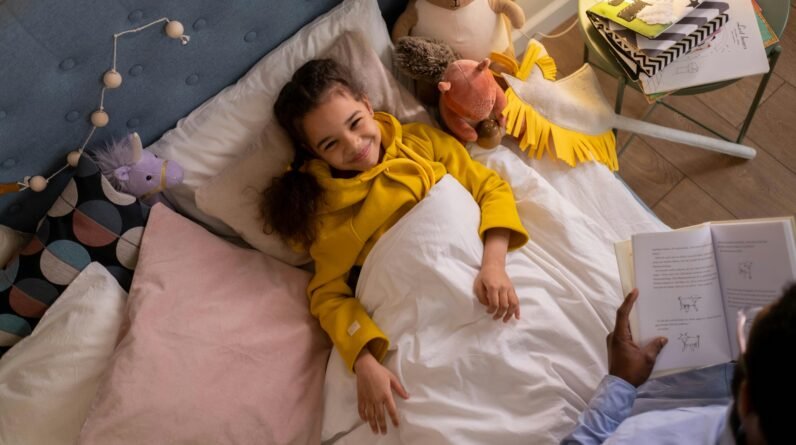
Image source: Unsplash.
5-Step Routine for Reading Short Bedtime Stories
A toddler story works best when it has a clear place inside the bedtime routine.
The story does not need to become the entire routine.
-
Lower the evening energy.
Finish active play and make the room quieter. -
Choose the story before reading begins.
Offer one or two appropriate options rather than browsing through many books. -
Read slowly.
Keep your voice warm and avoid overly dramatic character voices. -
Finish the story clearly.
Close the book or end the made-up story rather than adding new scenes. -
Use the same closing phrase.
Move directly into the final bedtime steps.
A simple closing phrase is:
“The story is done. The room is still. It is time to rest.”
For a broader evening framework, see our
bedtime routine that actually works
.
Best Themes for Short Toddler Sleep Tales
Familiar subjects are usually easier to keep calm than elaborate adventures.
| Theme | Why It Fits Toddler Storytime | Example |
|---|---|---|
| Animals | Familiar characters with simple emotions | Bear, bunny, mouse, owl, kitten |
| Moon and stars | Immediately creates a nighttime setting | Moon Mouse, Stars Say Goodnight |
| Blankets and pillows | Links the story naturally to bedtime | Bear’s Blanket |
| Nature | Supports slow, gentle imagery | The Quiet Garden |
| Favourite toys | Uses objects your child already knows | Tiny Truck Goes Home |
| Simple routines | Makes ending the day part of the story | Toys going to sleep |
Simple Calming Techniques to Use After the Story
If your child is still awake after the story, you do not necessarily need
to begin another book. Use a brief calming transition instead.
30-Second Closing Script
“The story is finished. Your blanket is warm.
Your bed is ready. We are quiet now. Goodnight.”
Simple Toddler Breathing Cue
Keep breathing activities playful and very brief:
“Smell the flower… now gently cool the soup.”
One or two slow breaths are enough.
Simple Body Wind-Down
- Wiggle toes, then let them rest.
- Squeeze hands gently, then open them.
- Lift shoulders, then let them soften.
- Let the head rest comfortably on the pillow.
Keep these activities optional. If they make your toddler more excited,
simply return to your normal goodnight routine.
How to Choose a Bedtime Story by Age
This article focuses specifically on short bedtime stories for toddlers,
but children’s story preferences naturally change as they grow.
-
Ages 2–3:
Choose very short stories with repetition, familiar objects,
and one simple action. -
Ages 3–4:
Add simple animal, moon, blanket, vehicle, or nature stories. -
Ages 4–5:
Introduce slightly longer stories with one gentle problem and resolution. -
Ages 5–6:
Move towards preschool stories with more dialogue and a little more plot.
For a broader age-based guide, visit
bedtime stories for kids by age
.
For children moving into early reading,
see our
reading stories for kindergarten
.
DIY Short Bedtime Story Template
You can make up a toddler bedtime story without inventing a complicated adventure.
Use five simple parts.
| Story Part | What to Add | Example |
|---|---|---|
| Character | One familiar animal, toy, or child | Little Bunny |
| Setting | One calm place | Moonlit garden |
| Gentle action | One simple thing happens | Bunny finds a blanket |
| Comfort | The character feels safe or settled | The blanket is warm |
| Closing line | One simple goodnight phrase | “Soft and slow, time to rest.” |
Fill-in-the-Blank Toddler Story
“[Character] went to [calm place]. There, [character] found [comforting thing].
The night was [soft word]. [Character] whispered, ‘[sleep cue].’
Then [character] closed their eyes and rested.”
You can use your child’s favourite teddy, toy car, animal,
or blanket as the main character.
A Simple 7-Night Short Bedtime Story Plan
You do not need seven completely different stories.
This plan simply helps you discover which themes your toddler finds most enjoyable.
| Night | Story Theme | Example |
|---|---|---|
| Night 1 | Animal | Moon Mouse |
| Night 2 | Moon or stars | Stars Say Goodnight |
| Night 3 | Comfort object | Bear’s Blanket |
| Night 4 | Favourite toy | Tiny Truck Goes Home |
| Night 5 | Nature | The Quiet Garden |
| Night 6 | Reassurance | The Sleepy Lighthouse |
| Night 7 | Repeat the favourite | Your child’s preferred story |
Repeating the favourite on Night 7 is intentional.
Toddlers often enjoy knowing what comes next.

Image source: Unsplash.
Common Mistakes to Avoid With Short Toddler Bedtime Stories
1. Choosing a Story That Is Too Long for the Evening
A longer story is not automatically better.
If your toddler is already tired, use a shorter story and finish calmly.
2. Making the Plot Too Exciting
Chases, frightening surprises, loud action, or dramatic cliffhangers
may make the story harder to wind down from.
3. Assuming You Need a New Story Every Night
Repetition is normal for toddlers.
A favourite story can become part of the routine.
4. Turning Storytime Into Question Time
Questions are wonderful for literacy during the day,
but bedtime may not be the best moment for a long discussion.
5. Starting Another Story After the Agreed Limit
If you agreed on one story, use your closing phrase when it ends.
Otherwise, “one more story” can easily become part of
bedtime negotiations
.
6. Reading Too Dramatically
Bedtime storytelling does not require a performance.
A warm, steady voice is enough.
Frequently Asked Questions About Short Bedtime Stories for Toddlers
How long should a bedtime story be for a toddler?
Many toddlers do well with stories lasting roughly 2–5 minutes,
although younger toddlers may prefer an even shorter story.
Use your child’s attention and energy level as the best guide.
Are short stories better than long stories for toddlers at bedtime?
Short stories can be especially practical because they are easier to finish
before a tired toddler loses interest. Longer stories are fine if your child enjoys them
and they fit comfortably within your bedtime routine.
What kinds of bedtime stories are good for toddlers?
Familiar animal stories, moon and star stories, blanket stories,
gentle toy stories, and simple nature stories are all good options.
Keep the plot easy to follow and the ending peaceful.
What should I do if my toddler asks for another story?
Decide the story limit before you begin.
If you have agreed on one story, acknowledge the request and calmly explain
that another story can be read tomorrow.
Can I repeat the same toddler bedtime story every night?
Yes. Many toddlers enjoy repetition because they know the characters,
words, and ending. You do not need to replace a favourite story simply
to provide novelty.
Can I make up my own short bedtime story?
Yes. Choose one familiar character, one calm setting,
one small action, and one clear bedtime ending.
You can even make your child’s favourite toy the main character.
What is a good closing phrase for a toddler bedtime story?
A simple option is:
“The story is done. The room is still. It is time to rest.”
What matters most is that the phrase feels natural for your family.
What is the difference between short bedtime stories and micro bedtime stories?
Short bedtime stories generally contain a complete miniature plot
and may take a few minutes to read.
Micro bedtime stories
are even shorter and are useful when you need an especially quick read.
Where can I find more bedtime stories specifically for toddlers?
Visit our main
Bedtime Stories for Toddlers
guide for broader toddler-focused story ideas and bedtime support.
Final Thoughts
Short bedtime stories for toddlers work best when they are easy to follow,
comforting, and simple enough to finish before your child’s attention begins to fade.
You do not need a long book or a new story every evening.
One familiar character, a gentle voice, and a predictable ending can be enough
to make storytime feel warm and manageable.
Start tonight with three simple steps:
- Choose one short story that fits your toddler’s current energy level.
- Read slowly without adding extra excitement.
- Finish with the same calm goodnight phrase.
Over time, the story itself can become a familiar part of the evening:
a small signal that playtime is ending, the room is becoming quiet,
and bedtime is near.